Fast track: 1 month
Documents are built on ready-made templates for HACCP plans, procedures, process maps and instructions, adapted to your business. Suitable when you need the certificate by a specific date.
from 700,000 ₸
Service · HACCP · ISO 22000
A food safety management system prevents unsafe food from reaching the consumer. It is based on the HACCP principles. We develop the system to ISO 22000 (ST RK ISO 22000) for food manufacturers and food service and support you until certification. Turnkey.
Process
The stages go in this order. Each one ends with a document or a decision.
Timing and cost
Documents are built on ready-made templates for HACCP plans, procedures, process maps and instructions, adapted to your business. Suitable when you need the certificate by a specific date.
from 700,000 ₸
All core and support processes are described and implemented, and risks are assessed at every stage of production, and prerequisite programmes, a decision tree and HACCP plans are developed. Takes 5 months on average and requires the involvement of top management.
from 1,500,000 ₸
Prices exclude VAT. The cost depends on the number of activities and the size of the company. The price is fixed in the contract and does not change during the work.
Principles
Outcome
Reviews
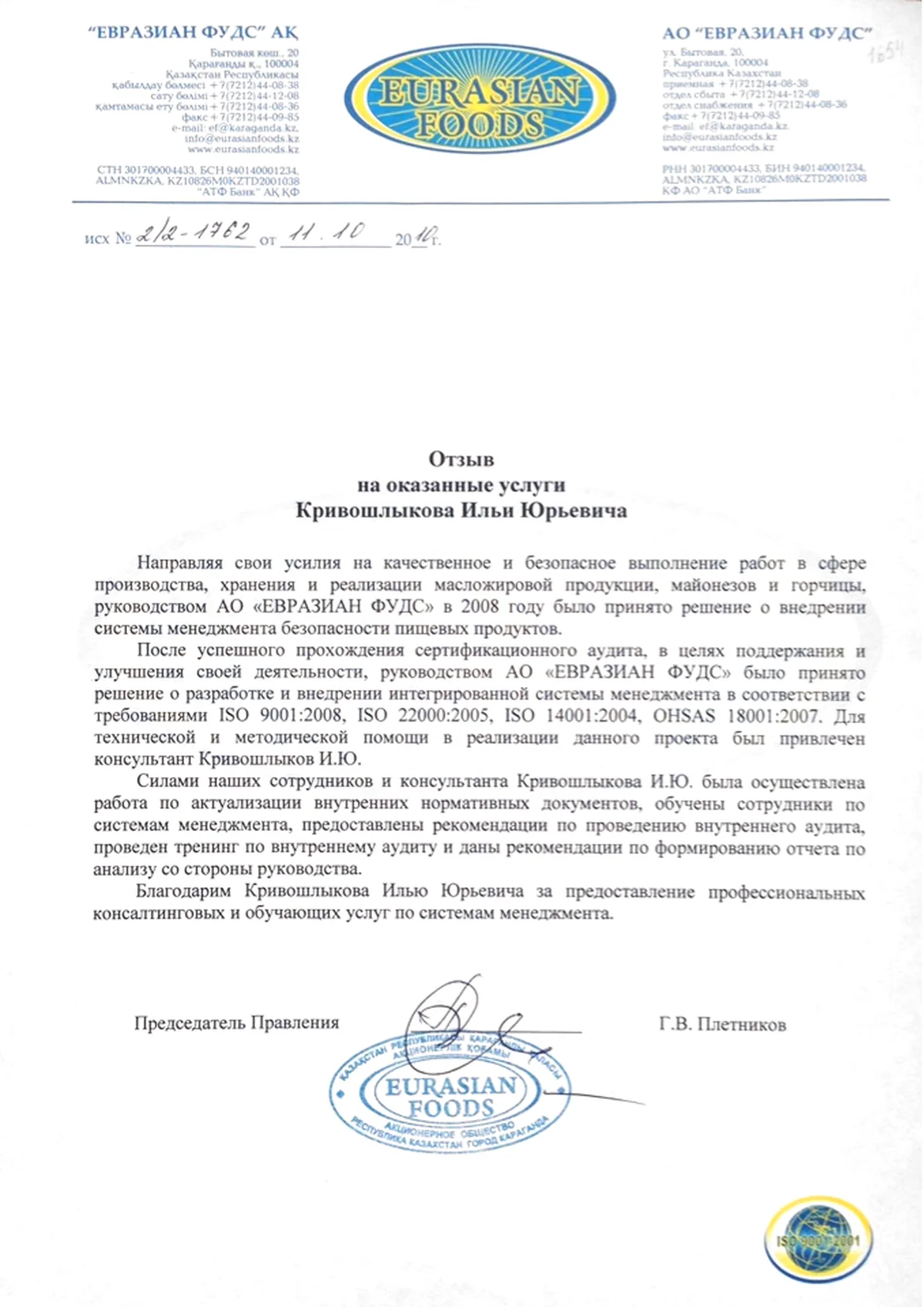
Integrated system, food safety · 2010
Our employees and the consultant I. Yu. Krivoshlykov updated the internal regulatory documents, staff were trained in management systems, recommendations were given on conducting internal audits, an internal audit training session was held, and recommendations were given on preparing the management review report.
Eurasian Foods JSCChairman of the Management Board G. V. Pletnikov
Open the letter · Original letter in Russian
Questions
It is a way to manage food safety: a company identifies in advance where in the process a hazard to the consumer can arise and puts permanent controls at those points. The name stands for Hazard Analysis and Critical Control Points.
Yes, for food manufacturers. Technical Regulation of the Customs Union TR CU 021/2011 “On Food Safety”, which applies in Kazakhstan, requires the manufacturer to develop, implement and maintain procedures based on the HACCP principles (Article 10). ISO 22000 certification, on the other hand, is voluntary: companies obtain it at the request of customers and retail chains.
HACCP is a set of principles for hazard analysis and control of critical points. ISO 22000 is an international management system standard that includes these principles and adds requirements for management, documentation and improvement. Certificates are issued against ISO 22000.
From 1 month, if documents are built on HACCP plan templates adapted to your production. Full implementation with risk assessment at every stage takes from 2 months to a year, 5 months on average.
Yes: the regulation requires the procedures to be developed and working, but does not oblige you to hire consultants. In practice it comes down to time and experience: you need a person who knows the HACCP principles and can lead a team without dropping their main job.
Three years. During this period the certification body carries out a surveillance audit once a year to check that the system works. After three years the company goes through recertification.
An accredited certification body, after auditing the company. SLA is a consulting company: we do not issue certificates — we prepare your system to pass the audit and support you during it.
Training
We run seminars on developing and implementing a food safety management system to ISO 22000 and train internal auditors.
Consulting and seminars are delivered in Russian. You can contact us in English.